Learning skeuomorphic UI craft
Learning skeuomorphic UI craft
Section titled “Learning skeuomorphic UI craft”Related: Windows XP Luna · Windows 7 Aero · Frutiger Aero · Y2K · Linux desktop shells (skeuomorph era) · 88x31 · Sadgrl layouts · Nekoweb and plain HTML · README
Summary
Section titled “Summary”Working thesis: Taste arrived top-down from OS vendors, consumer electronics, and magazine / Flash culture. Craft skill arrived bottom-up via View Source, free tutorials, theme/skin communities, Japanese sozai workshops, and reusable Photoshop / Fireworks / Paint Shop Pro recipes (gel, metal, plastic, glass, leather/wood). 88x31 and Aero glass are examples inside that curriculum, not the curriculum itself.
This note is the how-we-learned layer for the braid: Aqua gel, brushed metal, Luna plastic, Aero frost, iOS leather/linen — plus the apprenticeship channels that turned those looks into amateurable Layer Style grammar. It is not a synonym for any one specimen (Windows XP Luna, Windows 7 Aero, Y2K chrome).
Confidence: High on the dual path (vendor taste ↔ bottom-up craft), Aqua / Luna / Aero / iOS-skeuomorph timeline, and the Layer Styles recipe family as the common Photoshop-era grammar. Medium on any single “canonical” tutorial lineage and on Chinese 闪图 / flash-GIF paths as parallel curricula. Low on demography claims (who was majority where) without survey data.
Taste sources (top-down)
Section titled “Taste sources (top-down)”Vendor and media looks that amateurs then reverse-engineered:
| Source | Era cue | What learners stole |
|---|---|---|
| Apple Aqua | Mac OS X 2000 | Gel / candy buttons, translucency, “lickable” plastics (Jobs-era framing) — see Aqua (UI) |
| Brushed metal | QuickTime 4 (1999) → Panther-era abuse | Device-mimic chrome; Apple HIG limited use, Apple often ignored its own HIG (512pixels Brushed Metal Diaries, Daring Fireball) |
| WinXP Luna | 2001 | Soft blue / olive / silver bevels → msstyles / StyleXP / WindowBlinds communities — deep dive Windows XP Luna |
| Vista / Win7 Aero | 2006–2009 | Frosted glass, DWM blur — Windows 7 Aero / wider mood Frutiger Aero |
| iOS skeuomorph peak | Scott Forstall era → flat turn iOS 7 (2013) | Leather / wood / linen Calendar & Notes; then the industry flat reset |
| Consumer electronics + Flash + magazines | late-90s → mid-00s | Bondi candy shells, Flash showcase sites, Computer Arts cover CDs — hardware and print as taste tutors |
Taste is what looked desirable. Craft is how kids and hobbyists rebuilt it.
Craft curriculum (Layer Styles grammar)
Section titled “Craft curriculum (Layer Styles grammar)”The shared amateur toolbox was not “design school,” it was repeatable Photoshop recipes (plus Fireworks, Paint Shop Pro, sometimes MS Paint for simple skins, Ulead / PhotoImpact in some regions).
Gel / Aqua buttons
Section titled “Gel / Aqua buttons”Canonical amateur stack (SitePoint Corrie Haffly; Photoshop Elements Down & Dirty Tricks “Gettin’ Gelly”; “Yummy Metal” lineage):
- Shape layer + gradient overlay (light top → saturated mid → darker foot)
- Inner glow / outer glow for candy edge and halo
- Soft highlight ellipse (white, low opacity) near the top
- Often fill 0% on the shape + bevel & emboss so style, not flat fill, does the volume
Same grammar scales to pills, orbs, badge chips, and “wet plastic” chrome.
Brushed metal / material textures
Section titled “Brushed metal / material textures”- Noise → motion blur for brushed aluminum
- Pattern overlays for leather, wood, linen, carbon
- Soft bevels + satin / gloss for device bezels
Tools of the apprenticeship
Section titled “Tools of the apprenticeship”| Tool | Typical job |
|---|---|
| Adobe Photoshop | Full Layer Styles stack; most English tutorial canon |
| Macromedia / Adobe Fireworks | Web-optimized slices, button sets |
| Paint Shop Pro | Budget path; strong in some regions / forums |
| MS Paint | Crude skins, 88×31 drafts, icon dabbling |
| Ulead / PhotoImpact | Regional tutorial ecosystems |
Later (mid–late 00s): CSS gel buttons and sliding-doors sprites — the code path after the image path.
Apprenticeship channels (bottom-up)
Section titled “Apprenticeship channels (bottom-up)”How the curriculum actually spread:
- View Source / steal-my-layout — with credit ethics (copy, credit, mutate).
- Magazines + cover CDs — Computer Arts and peers shipping assets / trial tools.
- Books — craft manuals + history shelf: see What to read below (Weinman, Kelby, Haffly; Eskilson for history).
- Lynda.com courses — video Layer Styles pedagogy.
- Theme / skin communities — WinCustomize; WindowBlinds SkinStudio /
msstyles(UIS tutorial archive); Winamp skinners (bitmap +.uis). - DeviantArt brushes / textures packs.
- Japanese sozai ateliers — Fool Lovers, Sozai Museum lore; women-majority pixel / GIF craft; magazine competitions; strong credit / disclaimer culture (museum history).
- Friends, school clubs, IRC / forums — local transmission.
- Revival teachers — sadgrl archived layouts (Sadgrl layouts); blinkies.cafe how-tos mapped to 88x31; Nekoweb / plain-HTML pride (Nekoweb and plain HTML).
Plural paths, not one funnel. English Photoshop blogs, Japanese sozai, Winamp/WinCustomize skins, and (Medium confidence) Chinese 闪图 / flash-GIF craft ran in parallel. Demography claims stay Low confidence.
Worked examples (link out)
Section titled “Worked examples (link out)”| Craft object | Maps to concept |
|---|---|
| Friendship / host / webring chips | 88x31 |
| Frosted translucent chrome | Windows 7 Aero · Frutiger Aero |
| Porch / shrine homepage shells | Y2K layout · Sadgrl layouts · Nekoweb and plain HTML |
| Soft plastic OS bevels | Windows XP Luna |
| Candy translucent hardware romance | Aqua / Bondi (this note + Y2K hardware branch) |
Do / Don’t (for Designy)
Section titled “Do / Don’t (for Designy)”- Treat skeuomorph as accent craft — one gel CTA, one plastic frame, one frosted bar — inside a calm product default.
- Prefer Frutiger Aero calm as the default product shell; borrow Luna / Aqua / leather as ornament, not the whole viewport.
- Credit sozai / badge / layout sources when documenting or shipping revival assets.
- Learn the Layer Styles grammar once — gradient + glow + highlight + bevel — then translate to CSS (
linear-gradient, soft shadows, optionalbackdrop-filter). - Use revival teachers (Sadgrl layouts, 88x31 how-tos) as apprenticeship, not as license to mash every era at once.
- Don’t mash Aqua + Luna + Aero + McBling in one viewport without hierarchy.
- Don’t treat 88×31 or Aero glass as “the whole skeuomorph curriculum.”
- Don’t strip credit culture from sozai / steal-my-layout lineages.
- Don’t ship iOS-7-flat and wet-plastic maximalism as one unlabeled system.
- Don’t claim a single funnel (only Photoshop blogs, only Japanese sozai, only skin sites) — paths were plural.
Iconic references
Section titled “Iconic references”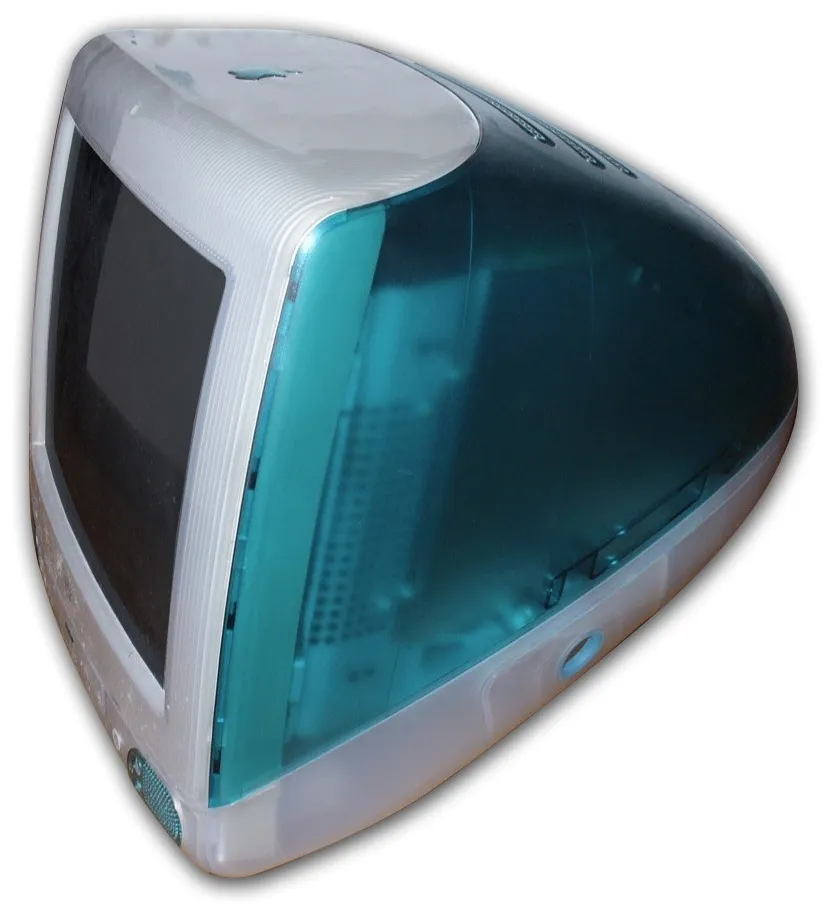 Bondi Blue iMac G3 — translucent candy-shell hardware that fed Aqua / gel taste (lickable plastics as consumer romance).
Source: Wikimedia Commons — IMac Bondi Blue.jpg · License: CC BY-SA 2.0 · Also embedded from Y2K (filename design-y2k-imac-bondi-blue).

 Luna title-bar caption buttons — soft plastic bevel craft reverse-engineered in
 msstyles / skin communities.
Source: Wikimedia Commons — VirtualBox … LUNA NORMAL.png · License: PD-shape · Also in Windows XP Luna.

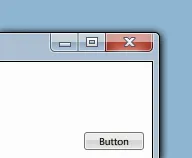 Aero glass window chrome — frosted-glass end of the same apprenticeship arc (blur / translucency as OS taste).
Source: Wikimedia Commons — Aero UI.png · License: CC BY-SA 4.0 · Also in Windows 7 Aero.

What to read (books)
Section titled “What to read (books)”Honest gap first: there is no single canonical history book titled around Aqua / Luna / skeuomorphic UI the way there is for Bauhaus or Swiss modernism. The closest useful shelf mixes (A) design-history surveys, (B) period craft manuals that taught the look, and (C) theory / oral history that explains why interfaces looked like objects.
A. Design history (best “what happened” books)
Section titled “A. Design history (best “what happened” books)”| Book | Why it helps this braid | Caveat |
|---|---|---|
| Stephen J. Eskilson — Digital Design: A History (Princeton, 2023) | Closest one-volume survey of digital design as a field: Web 1.0 → Web 2.0 / Flash era, product “sexy plastic,” interfaces as culture. Heller called it foundational for future study. | Broad survey — not a deep Aqua/Luna monograph. Chapters 5 (Web 1.0), 7 (Web 2.0), 9 (Sexy Plastic) are the highest-yield for this note. |
| Bill Moggridge — Designing Interactions (MIT Press, 2007) | Oral history of interaction design (desktop metaphor, handhelds, web) from an IDEO founder — how professionals thought about UI while hobbyists were learning gel buttons. | Industry / HCI lens more than Photoshop craft. |
| Jay David Bolter & Diane Gromala — Windows and Mirrors (MIT Press, 2003) | Theory of digital design as medium (transparency vs reflection) against the “invisible appliance” myth — useful for understanding why skeuomorph wanted to be seen. | Philosophy / digital-art leaning; not a how-to. |
| Cliff Kuang (with Robert Fabricant) — User Friendly (2019) | Popular history of user-friendly design; good companion for the taste stack (products + interfaces). | Broader than 1999–2013 chrome. |
Also visual-adjacent (hardware taste, not UI chrome): Apple / Jony Ive — Designed by Apple in California (2016) is a photo archive of 1998–2015 products (Bondi → Pencil). Excellent for candy-plastic / aluminum hardware romance that fed Aqua taste; not a software UI history.
B. Period craft manuals (how people actually learned the recipes)
Section titled “B. Period craft manuals (how people actually learned the recipes)”These are the books that sat next to Photoshop — apprenticeship, not historiography:
| Book | Role |
|---|---|
| Lynda Weinman — Designing Web Graphics (New Riders; esp. late-90s editions) | Early bridge from print design → web images; classroom voice for a generation preparing GIFs / buttons / web color. |
| Scott Kelby — Photoshop Down & Dirty Tricks (incl. Elements editions: “Gettin’ Gelly,” “Yummy Metal”) | Recipe books for gel / metal buttons — the Layer Styles curriculum in print. |
| Corrie Haffly — The Photoshop Anthology (SitePoint) | Button / web-graphics technique anthology; same gel-button lineage as her SitePoint tutorials. |
| Jennifer Niederst Robbins — Learning Web Design / Web Design in a Nutshell | Structure + reference for building sites while the graphics books taught the chrome. |
| Steve Krug — Don’t Make Me Think (2000 / later eds.) | Usability commons — not skeuomorph craft, but the period’s “obvious clickable control” ethic that gel buttons served. |
| Robin Williams — The Non-Designer’s Web Book | Beginner visual literacy for personal / small-business webmakers. |
| OS Missing Manuals (Pogue: Mac OS X, Windows XP) | How civilians met Luna / Aqua day-to-day — taste by immersion. |
Magazine path that functioned like a book club: Computer Arts (and peers) with cover CDs of tutorials / assets — monthly apprenticeship more than a single title.
C. Short reading order for Noa
Section titled “C. Short reading order for Noa”- Eskilson Digital Design — Ch. 5, 7, 9 (history spine).
- Skim Bolter & Gromala Windows and Mirrors if you want the “why interfaces look like things” argument.
- One craft recipe book (Kelby or Haffly) if you want to make gel/metal, not only read about it.
- Keep Weinman as the period pedagogy ancestor; keep this vault note + Windows XP Luna / Windows 7 Aero for specimen deep-dives.
Confidence: High that Eskilson is the best current history survey for this territory. High that Weinman / Kelby / Haffly are the real craft bookshelf of the era. Medium on any claim that a single book “covers skeuomorphic UI history” end-to-end — the literature is still sparse and split across HCI, graphic design history, and how-to manuals.
Sources
Section titled “Sources”- https://en.wikipedia.org/wiki/Aqua_(user_interface) — Aqua gel / translucency taste
- https://512pixels.net/2013/03/brushed-metal-intro/ — Brushed Metal Diaries
- https://daringfireball.net/2004/10/brushedmetal — HIG vs practice on brushed metal
- https://www.sitepoint.com/building-buttons-photoshop-2/ — Corrie Haffly gel / button Layer Styles
- https://www.oreilly.com/library/view/photoshop-r-elements-3/0321278356/chapter-63.html — Down & Dirty “Gettin’ Gelly”
- https://archive.stardock.com/products/windowblinds/skinning/uis1tutorial.html — WindowBlinds / UIS skinning apprenticeship
- https://dmansweb.neocities.org/museumhistory — Japanese sozai atelier / museum lore
- https://en.wikipedia.org/wiki/Lynda_Weinman — Weinman / early web-graphics pedagogy
- Cross-links: Windows XP Luna, Windows 7 Aero, Frutiger Aero, Y2K, 88x31, Sadgrl layouts, Nekoweb and plain HTML
- Skeuomorphism → flat (iOS 7) — cite carefully from period Ars / Slate commentary when quoting industry turn; treat as secondary color, not primary craft how-to
- https://press.princeton.edu/books/hardcover/9780691181394/digital-design — Eskilson Digital Design: A History
- https://thehistoryoftheweb.com/the-books-that-shaped-how-we-learn-about-the-web/ — Weinman / Robbins web-learning bookshelf
- https://mitpress.mit.edu/9780262134743/designing-interactions/ — Moggridge Designing Interactions
- https://en.wikipedia.org/wiki/Designed_by_Apple_in_California — hardware photo archive (taste, not UI chrome)